

Unless you’ve been living under a rock, you’ve probably heard about the gold mania this past year. So naturally, like totally normal people (yes, this is sarcastic), my friends and I spent last night debating gold investments over dinner.
I spent my morning today (I confess: it was not boring) in the gold rabbit hole trying to understand my options as a German resident and how to optimize gains (of course assuming that gold will increase and not fall). This is not about if you should buy gold or not, but about if you decided to buy, what and how to buy.
What are the options?
Not a surprise but buying gold in Germany is way more complex than it looks—and that complexity creates some genuinely interesting opportunities. For individuals, there are basically three options:
Physical gold - actual gold bars you hold in your hand and store at home or in a safe.
ETCs with delivery rights - you own shares but can claim physical gold if you want.
ETCs without delivery rights - pure paper gold, like any other commodity investment.
In most countries, options 2 and 3 would be treated the same. But this is Germany, where nothing is simple—and that’s exactly where the opportunity is.
Option 1: Physical Gold
You can walk into any gold shop and buy pure gold bars or coins. No VAT on pure gold, but you’ll pay a commission and get hit with a significant spread between buy and sell prices.
Quick math: a 10g gold bar costs around €1,395 at retail (example here), versus about €1,343 for the equivalent in ETCs. That’s a €52 premium - roughly 4% more just to hold the physical metal.
The Tax Treatment
If you hold physical gold for more than one year, you pay zero taxes on capital gains when you sell. None. Yes you read it right. But if you sell before one year, things get weird thanks to §23 EStG (private sale transactions):
If your total profits from ALL private sales in a calendar year (gold, crypto, art, NFTs, whatever) stay under €1,000, everything is tax-free
If you cross €1,000, the entire profit gets taxed as “other income” at your marginal rate (14-45% plus solidarity surcharge)
This is per person, resets every calendar year
Example:
€999 profit → €0 tax
€1,200 profit → €1,200 gets fully taxed (not just the €200 over the threshold)
Plan accordingly.
Option 2: ETCs with Gold Delivery Rights
In the EU, gold is sold as ETCs (Exchange Traded Commodities), not ETFs—long story.
Two ETCs in Europe let you claim physical gold:
Xetra-Gold (4GLD): DE000A0S9GB0
EUWAX Gold II (EWG2): DE000EWG2LD7
Both have 0% TER (management fees), but you pay small storage and transaction costs—total ownership cost is around 0.3-0.4% annually.
The Tax Trick
In Germany specifically, ETCs with delivery rights are treated exactly like physical gold for tax purposes. Same rules: hold for more than a year, pay zero capital gains tax. Under a year, you’re subject to the €1,000 threshold rule.
This is important. You get:
Lower upfront cost (no 4% premium)
Lower ongoing cost (0.3-0.4% vs potential storage/insurance for physical)
Easy liquidity (sell instantly on the exchange)
Same tax treatment as physical gold
I haven’t found another EU country that does this. It’s a German special.
Option 3: Regular ETCs (No Delivery)
This is straightforward ETF (equity)-style investing. You pay low fees (e.g., 0.12% for SGLN) and you’re taxed like stocks: 26.375% flat capital gains tax (Abgeltungsteuer) on all profits, regardless of holding period.
So What Should You Actually Do?
I’m not a financial advisor and I can’t make decisions for you, but here’s my mental model:
Buy physical gold if:
You’re genuinely paranoid about systemic collapse
You’re highly mobile and want truly portable wealth
You live somewhere you can’t access gold-backed financial products
You plan to hold for decades
Yes, you pay a premium upfront, but you own it for real with no ongoing costs.
Buy 4GLD or EWG2 if:
You live in Germany
You plan to hold for more than a year, OR Your total private sale profits for the year will stay under €1,000
You’re willing to deal with the tax reporting
This is the sweet spot for most people in Germany who want gold exposure (IMO).
Buy SGLN or similar if:
You’re not in Germany, OR
You want to trade actively, OR
You value simplicity over tax optimization
Just pay the 26.375% and move on with your life.
Numbers
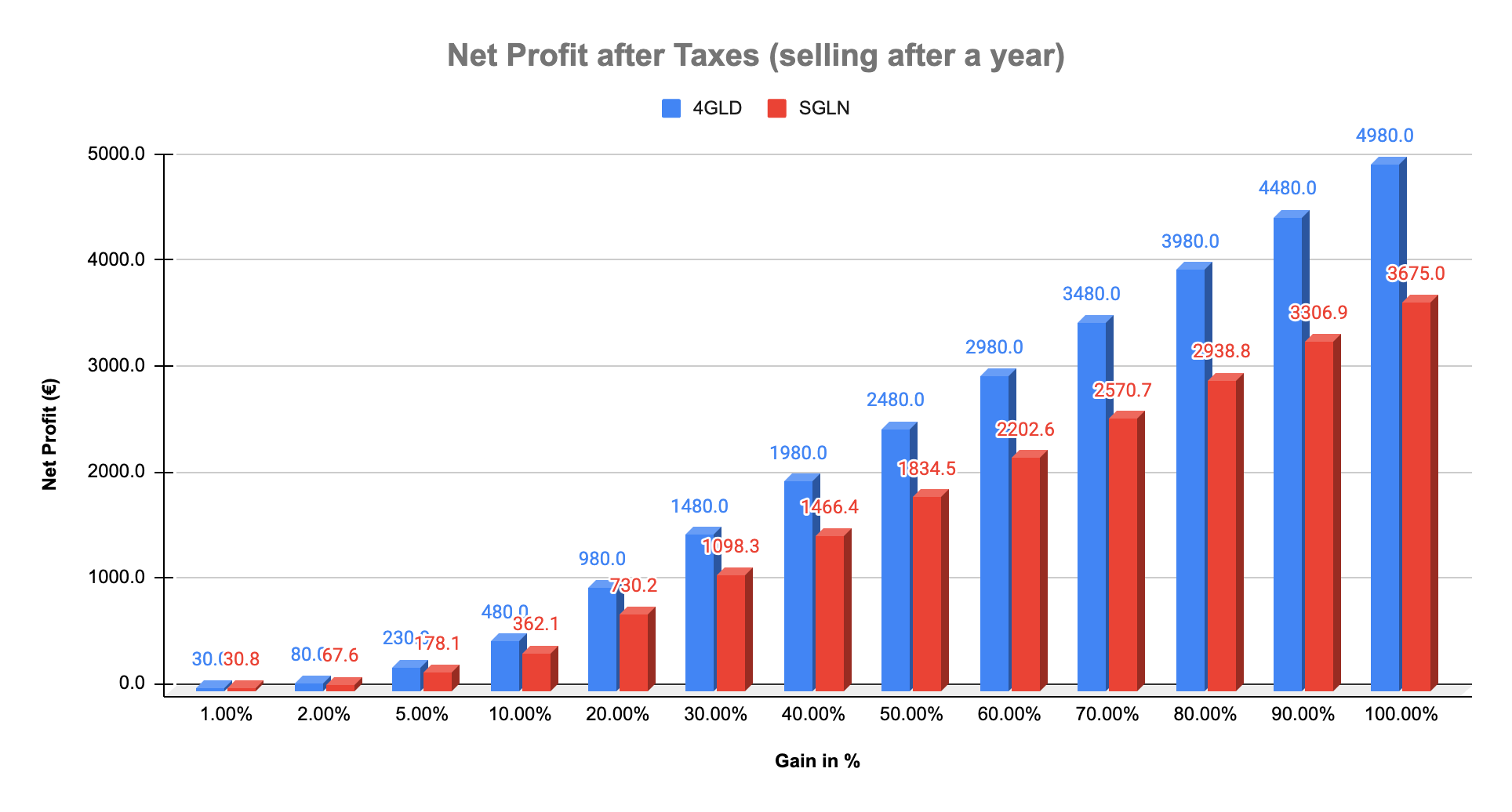
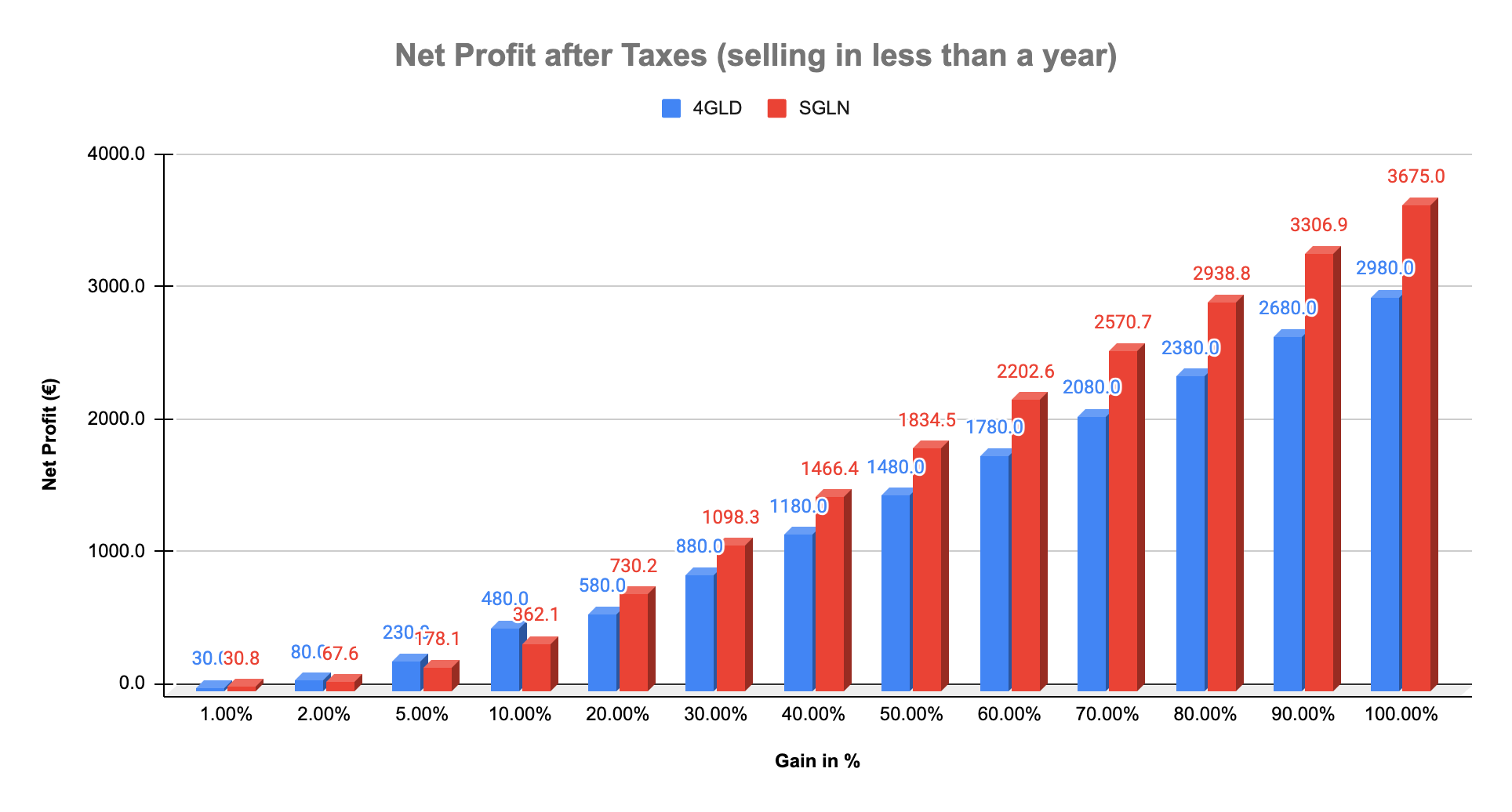
As I love speaking with data, I did some math calculations assuming €5,000 gold investment with 40% personal tax rate. I also assumed that anyone who owns €5,000 gold would probably own much more in ETFs so they will use their yearly tax allowance on normal ETFs. (Google Sheet here)
If you are selling after 1 year of ownership, you will be better off buying 4GLD for any gains above 1% with very little differences on 1% or below. See Graph.
If you are selling before 1 year, things are more complex but you will be better off buying 4GLD if you are anticipating profit less than 10% and better off buying SGLN for anything more. See Graph
Of course these numbers are my calculations and I might be totally wrong, so take it with a pinch of salt.
The Bottom Line
The deliverable ETC route is probably the best option for most people in Germany who want gold exposure. You get the tax benefits of physical gold without the premium, storage headaches, or liquidity issues.
The fact that almost nobody talks about this suggests either (a) I’m missing something, or (b) it’s a genuine arbitrage that exists purely because of regulatory complexity. Given that this is Germany we’re talking about, I’m betting on (b).
References:
Usual disclaimer: This is my understanding after reading the actual laws and cross-referencing multiple sources. I’m not a tax professional. Verify everything yourself before making decisions.